
Reclaimr Pay History
They paid for it last time. Now your rebuttal says so.
When an insurer leaves an operation off your estimate that it has paid at your shop before, Reclaimr finds those earlier repair orders and puts them in your rebuttal.
Same shop, same insurer, both answers
The same line, written the same way, at the same shop, for the same insurer. Paid on one file. Cut on the next. We looked at every shop that wrote an operation on five or more files with one insurer: in 44 of those 60 cases, the insurer gave both answers.
Eight examples, one square per file, oldest first
Paid in fullCutSome of each
Shops and insurers are not named. 305 short pays, 24,134 shop lines, 48 shops, November 2025 to September 2026, customer shops only. A row is one shop, one insurer and one operation the shop wrote on five or more files.
Nothing about the operation changed between those files. What changed was the answer. That is exactly what an earlier repair order shows the adjuster.
Can they cut something they paid for last time?
They can. What they can’t do, in most states, is cut it without a reason.
- The cut has to be explained. Nearly every state has an unfair claims practices law based on the NAIC’s model act.[2] It makes it an unfair practice to fail to give “a reasonable and accurate explanation of the basis” for a denial or a compromise settlement.[1]
- A policy reason has to be named. Under the NAIC’s model regulation, an insurer can’t deny a claim on a policy provision, condition or exclusion unless the written denial names it.[3] An internal guideline is not a policy provision.
- The estimate has to fix the car. The same regulation says the insurer’s estimate “shall be reasonable, in accordance with applicable policy provisions, and of an amount which will allow for repairs to be made in a workmanlike manner.”[3]
- Some states want it line by line. In California, an insurer that adjusts the shop’s estimate must “identify the specific adjustment made to each item and the cost associated with each adjustment.”[4]
That’s where Reclaimr Pay History comes in. If it is cut this time with no reason given, the RO number puts the question where it belongs: what is different about this car?
What a past payment doesn’t prove. Every repair is different. An earlier RO doesn’t show that this car needed the operation; your estimate line and the industry guidelines do that. The RO shows the insurer already recognizes the operation as a billable cost at your shop.
Rules differ by state, and between an insurer’s own customer and a claimant under someone else’s policy. This section summarizes public rules for education. It is not legal advice.
How Reclaimr does it

Tony is the AI inside Reclaimr. He reads your estimate and the insurer’s line by line, finds every operation they left off or wrote lower, and writes the argument to get it back, with industry guidelines behind it. Pay History adds what Tony can’t see in one estimate: your history with this insurer.
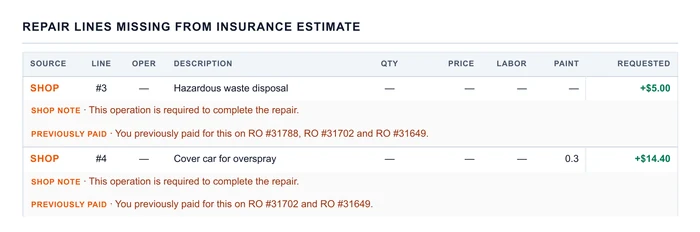
- Tony finds what was left off.Every operation on your estimate with no line on the insurer’s.
- Reclaimr checks your files.Every earlier file at your shop with the same insurer, for a repair order where that insurer paid the same operation.
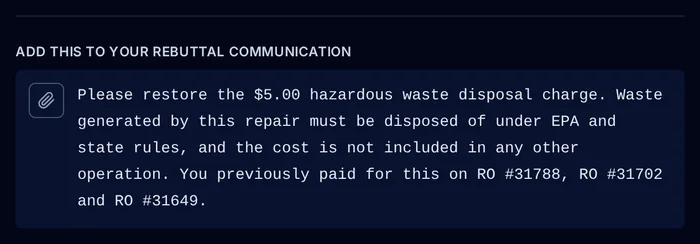
- The RO goes in your rebuttal.Up to three, most recent first, in the argument you send and in your Supplement Overview.
- It stays true.If a file moves, the insurer on the case changes, or the insurer adds the item back, the citation comes off.
The rules it follows
- The RO numbers come from your records, never from the AI. Tony writes the argument. The program adds the repair orders after, so an RO number can’t be made up.
- Your shop and the same insurer only. Never another shop’s files, never another insurer’s claims.
- Only the RO number. Never the customer, vehicle or claim from the other file.
- Only when it was left off completely. A line the insurer wrote lower gets its own argument, not an RO citation.
Operations it checks
Hazardous wasteColor tint and matchColor sand and buffCover car and maskingClear coatFlex additiveFeather, prime and blockCorrosion protectionPre-repair scanPost-repair scanHeadlamp aimCalibrations, by systemBlendThree-stageSpray-out panelAdhesion promoterRefinish edges
Sources and method
- NAIC, Unfair Claims Settlement Practices Act (Model 900), Section 4(L), and 4(D) on good-faith settlement. content.naic.org
- NAIC, Unfair Claims Settlement Practices Act, state adoption chart. content.naic.org
- NAIC, Unfair Property/Casualty Claims Settlement Practices Model Regulation (Model 902), Sections 7(A) and 8(E). content.naic.org
- Cal. Code Regs. tit. 10, § 2695.8(f). law.cornell.edu
- Reclaimr data. “3 out of 4”: 44 of 60 shop, insurer and operation combinations written on five or more files, from 305 short pays at 48 shops, November 2025 to September 2026. “1 out of 4”: 97 of 361 short pays where the insurer’s estimate left one of the operations above off had an earlier file at the same shop, with the same insurer, that paid it, November 2025 to October 2026. Customer shops only; internal and test accounts excluded.
See which operations your insurers already paid for.
Bring a short pay. We’ll show you the argument, the industry guidelines and the repair orders.